
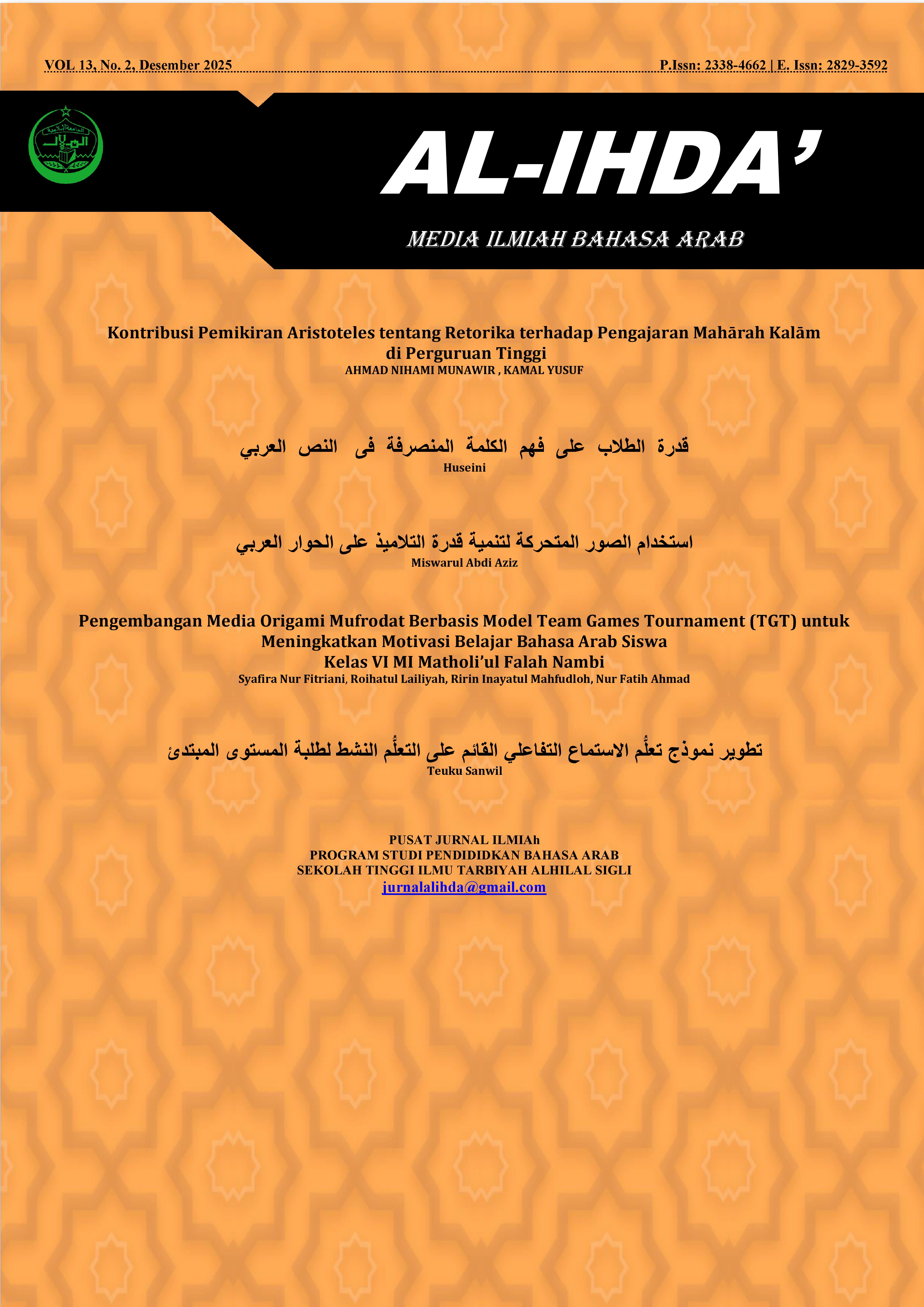
Kontribusi Pemikiran Aristoteles tentang Retorika terhadap Pengajaran Mahārah Kalām di Perguruan Tinggi
DOI:
https://doi.org/10.58645/alihda.v13i2.732Keywords:
Education, Arabic language, rhetoricAbstract
Rhetoric as the art of effective speaking has received considerable attention since Ancient Greece, particularly through the writings of Aristotle. In his work Rhetorica, Aristotle emphasizes three main aspects of persuasion, namely ethos (the credibility of the speaker), pathos (emotional appeal), and logos (the power of logic and argumentation). These three concepts have significant relevance in the context of teaching mahārah kalām (speaking skills) in higher education, especially in Arabic language learning. Mahārah kalām requires not only the ability to express words linguistically correctly, but also the skills to construct arguments, convince audiences, and adapt speaking styles to social and academic contexts. Through the integration of Aristotle's rhetorical principles, students can be trained to develop more comprehensive communication skills, including clarity of ideas, logical strength, and effective delivery. This study confirms that the teaching of mahārah kalām in higher education can be improved by adapting classical rhetoric theory as a pedagogical foundation that complements modern learning methods. Thus, Aristotle's thinking is not only relevant in Western philosophical tradition, but can also make a real contribution to the development of critical, logical, and persuasive Arabic language skills.
References
Abdul Ghofur, and Restu Budiansyah Riski. “Pendidikan Bahasa Arab Di Era Digital : Tantangan , Peluang Dan Strategi Menuju Pembelajaran Yang Efektif.” EL-FUSHA: Jurnal Bahasa Arab Dan Pendidikan 5, no. 1 (June 30, 2024): 15–28. https://doi.org/10.33752/el-fusha.v5i1.6697.
Ade, Sry, Muhtya Gobel, and Idewi Usman. “Komunikasi Persuasif : Seni Mempengaruhi Tanpa Memaksa” 1 (2025): 36–47.
Al-pares, Jodi. “DIGITAL RHETORIC AND THE TRANSFORMATION OF POLITICAL COMMUNICATION: AN ANALYSIS OF ETHOS, PATHOS, AND LOGOS IN POST-TRUTH ERA SOCIAL MEDIA CAMPAIGNS.” LinguAmerta 2, no. 1 (August 31, 2025): 35–41. https://doi.org/10.32722/jla.v2i1.7774.
Bahraini, Laisa, Istiqomah, Anita Verawati, and Putri Adinda Ayudiyanti. “Analisis Metode Pembelajaran Maharatul Kalam Tingkatan KMI Gontor Dan Universitas Darussalam Gontor.” Shibghoh 2, no. (2023): 33. https://ejournal.unida.gontor.ac.id/index.php/shibghoh/article/view/11033.
BANI, MOH YUSUF. “MANAJEMEN PEMBELAJARAN BAHASA ARAB MELALUI GURU PENUTUR ASLI (NATIVE SPEAKER) DALAM MENINGKATKAN MUTU BERBAHASA ARAB SANTRI AL-WAFI ISLAMIC BOARDING SCHOOL DEPOK JAWA BARAT,” 2023.
Dhia, Rifqi Nadhmy, Jasmine Alya Pramesthi, and Irwansyah Irwansyah. “ANALISIS RETORIKA ARISTOTELES PADA KAJIAN ILMIAH MEDIA SOSIAL DALAM MEMPERSUASI PUBLIK.” Linimasa : Jurnal Ilmu Komunikasi 4, no. 1 (August 1, 2024): 81–103. https://doi.org/10.23969/linimasa.v4i1.3530.
Dhia, Rifqi Nadhmy, Jasmine Alya Pramesthi, Pascasarjana Departemen Komunikasi, and Universitas Indonesia. “ANALISIS RETORIKA ARISTOTELES PADA KAJIAN ILMIAH MEDIA” 4, no. 1 (2021).
Green, Bill, Paul Molyneux, and Janet Scull. “Rhetoric , Agency , Pedagogy : A ‘ New ’ Perspective on Language and Literacy Education,” 2022, 297–308.
Hafer, Catherine, Federica Izzo, and Dimitri Landa. “Argumentation Strategies in Party Competition,” no. April (2025): 1–15. https://doi.org/10.1111/ajps.12983.
Hastang an nur. “Strategi Pengembangan Maharah Kalam Mahasiswa” 4, no. 2 (2023): 1–9. https://doi.org/https://doi.org/10.30863/awrq.v4i2.6010.
Kinasih, P. R. “Penerapan Retorika Aristoteles Sebagai Strategi Persuasi Pesan Layanan Masyarakat Oleh Gen Alpha ( Kegiatan Abdimas Di SMA Fons Vitae 1 Jakarta ) The Application of Aristotle ’ s Rhetorical Theory as a Persuasion Strategy of Public Service Announcements B,” no. April (2025). https://doi.org/doi.org/10.62383/transformasi.v2i2.1327.
Kustati, Martin. “Insights from a State Islamic University on Arabic Education as a Catalyst for Religious Moderation in Indonesia” 8, no. 3 (2024): 533–49.
Linda Asmara, Triono Ali Mustofa. “Strategi Guru Bahasa Arab Dalam Meningkatkan Maharotul” 10, no. 2 (2024): 1531–41.
Mappiara, Zahra Atika, Muh Arif, Mukhtar I Miolo, and Suleman D Kadir. “Isu Dan Problematika Dalam Pembelajaran Maharah Kalam” 2, no. 1 (2024): 48–61.
Marzuki, Alwi Hadad, and Dinda Ratulangi. “Retorika Dan Teknik Debat Politik.” Jurnal Multidisiplin Ilmu Akademik 2, no. 4 (2025): 560–74. https://doi.org/https://doi.org/10.61722/jmia.v2i4.5689.
Mohamad, Hairul Azhar. “Analysis of Rhetorical Appeals to Logos, Ethos and Pathos in ENL and ESL Research Abstracts.” Malaysian Journal of Social Sciences and Humanities (MJSSH) 7, no. 3 (March 10, 2022): e001314. https://doi.org/10.47405/mjssh.v7i3.1314.
Moore, Rebecca, and Howard Sandra. “The Ethics of Teaching Rhetorical Intertextuality.” Journal of Academic Ethics, no. June (2021): 385–405. https://doi.org/10.1007/s10805-021-09424-2.
Mujib, Abdul, Encep Taufik Rahman, Chatib Saefullah, Tata Sukayat, and Ridwan Rustand. “Pengembangan Bahan Ajar Retorika Melalui Publikasi Di Channel Youtube Sebagai Upaya Membangun Kepercayaan Diri Mahasiswa Tampil Di Depan Publik,” 2022.
Muttaqien, Agung, and Faedurrohman. “Strategi Pelatihan Bahasa Arab Dengan Metode Debat Bagi Mahasiswa Komunitas Al- Kindy Di Pusat Ma ’ Had Al - Jaami ’ Ah Pendahuluan Dalam Menjalankan Tugas Pokok Dan Fungsi Sebagai Mahasiswa Di Suatu Perguruan Tinggi . Tidak Sepatutnya Mahasiswa Berputar.” Al-Muyassar: Journal of Arabic Education 1, no. 1 (2023): 28–39.
Rokibullah, Rokibullah. “Integrasi Retorika Klasik Dan Prinsip Qur’ani Dalam Strategi Dakwah Islam Kontemporer.” Jurnal Impresi Indonesia 4, no. 7 (July 30, 2025): 2769–84. https://doi.org/10.58344/jii.v4i7.7053.
Sanjaya, Budi, and Wahyu Hidayat. “Student Speaking Skill Assessment : Techniques and Results” 11, no. 4 (2022). https://doi.org/10.11591/ijere.v11i4.22782.
Septiani, Melinda, Muhammad Isro, Kadek Litsya, and Melinda Septiani. “The Role of Language , Logic , Mathematics , and Statistics in Scientific Reasoning” 1, no. 2 (2025): 7–13.
Valentina, Beatrix, Maheswari Nabila, Shafa Aulia, Jasmine Salsabilla, and Moses Glorino. “PENTINGNYA MEMILIKI KEAHLIAN RETORIKA BAGI MAHASISWA,” 2020, 1–23.
Valeria, Laura, and Moreno Ramírez. “Advertising Semiotics and Its Impact on Consumer Emotions Semiótica Publicitaria y Su Impacto En Las Emociones Del Consumidor,” 2025. https://doi.org/10.62486/agma2025128.
Wijaya, Mualim, and Ayu Trisnawati. “Implementasi Pendekatan Communicative Learning Dalam Meningkatkan Maharah Kalam Di Marhalah Wustho Lembaga Pengembangan Bahasa Asing Nurul Jadid.” AS-SABIQUN 7, no. 1 (January 1, 2025): 155–69. https://doi.org/10.36088/assabiqun.v7i1.5567.
Downloads
Published
How to Cite
Issue
Section
License
Copyright (c) 2026 AHMAD NIHAMI MUNAWIR, KAMAL YUSUF

This work is licensed under a Creative Commons Attribution 4.0 International License.


