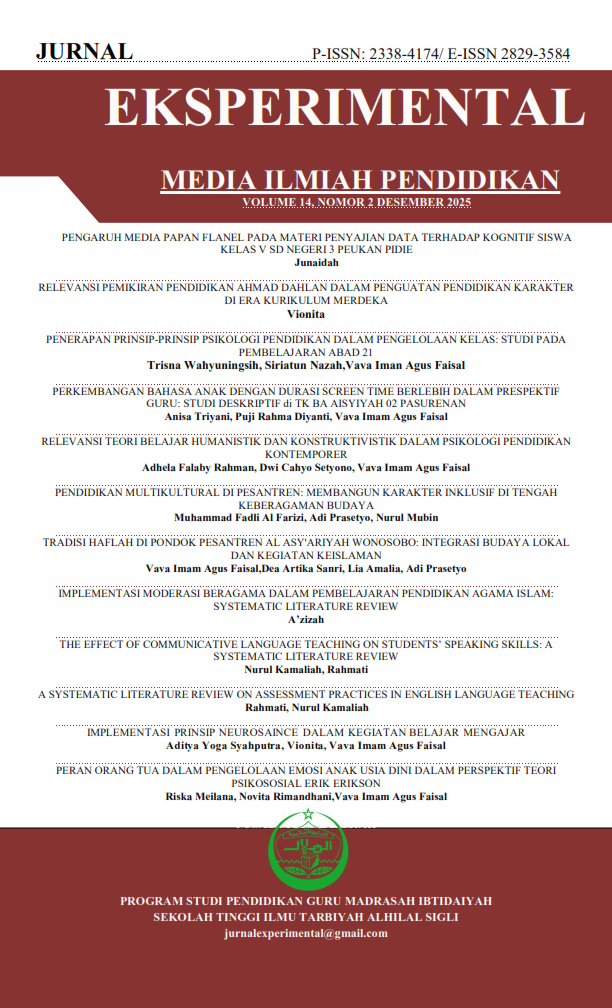
IMPLEMENTASI PRINSIP NEUROSAINCE DALAM KEGIATAN BELAJAR MENGAJAR
Keywords:
neuroscience education, teaching and learning activities, active learning, Primary SchoolAbstract
This study aims to describe the implementation of Neuroscience principles in teaching and learning activities at SD Negeri Bumireso. The study used a descriptive qualitative approach to obtain an in-depth picture of learning practices that are aligned with the workings of the brain of elementary school students. The research procedure is carried out through the stages of planning, implementation of data collection, data analysis, and conclusion. Data collection techniques include in-depth interviews with teachers as well as direct observation of the learning process in the classroom. The data were analyzed by means of data reduction, data presentation, and thematic conclusions. The results showed that the principles of neuroscience have been applied practically in learning, among others, through the creation of a safe and conducive learning environment, active learning that involves students directly, the provision of positive reinforcement, as well as the Association of learning materials with students' real experiences. The implementation has an impact on increasing students ' attention, motivation, and involvement in learning. This study shows that the application of Neuroscience principles contributes positively to improving the quality of teaching and learning in primary schools.
References
Ansari, D., De Smedt, B., & Grabner, R. H. 2012. Neuroeducation - A Critical Overview Of An Emerging Field. Neuroethics, 5(2), 105–117. https://doi.org/10.1007/s12152-011-9119-3
Caine, R. N., & Caine, G. 2011. Commentary: How New Research on Learning Is Re - Writing How Schools Work and Teachers Teach. LEARNing Landscapes, 5(1), 19–26. https://doi.org/10.36510/learnland.v5i1.527
Davis, R., & Singh, N. 2020. Neuroscience and Education: A Practical Guide. https://doi.org/10.1016/j.linged.2018.03.005
Depdiknas. 2003. Undang-Undang Republik Indonesia Nomor 20 Tahun 2003 tentang Sistem Pendidikan Nasional. Zitteliana, 19(8), 159–170.
Djamaluddin, A., & Wardana, W. 2021. Belajar dan Pembelajaran Teori, Desain, Model Pembelajaran dan Prestasi Belajar. Jakarta : Kaafah Learning Center
Goleman, D. 2015. Emotional Intelligence. Leadership in Practice: Essentials for Healthcare and Public Health Leaders, 77–96. https://doi.org/10.1891/9780826149244.0005
Goswami, U., & Bryant, P. 2007. Research Survey 2/1a. In Review Literature And Arts Of The Americas.
Immordino-Yang, M. H. 2011. Implications of Affective And Social Neuroscience For
Educational Theory. Educational Philosophy and Theory, 43(1), 98–103. https://doi.org/10.1111/j.1469-5812.2010.00713.x
Jensen, E. 2013. Engaging Students With Poverty In Mind: Practical Strategies For Raising Achievement. ASCD.
LeDoux,, J. 2012. Rethinking the Emotional Brain. Neuron, 73(4), 653–676. https://doi.org/10.1016/j.neuron.2012.02.004
Limbong, I., Rahmawati, D., & Wulandari, R. 2024. Pembelajaran Berbasis Neurosains dalam Pendidikan Sekolah Dasar. Jurnal Pendidikan Tambusai, 8, 9190–9194. https://jptam.org/index.php/jptam/article/view/13779
Pekrun, R. 2021. Control-Value Theory: From Achievement Emotion to a General Theory of Human Emotions. Springer US, 36(3) https://doi.org/10.1007/s10648-024-09909-7
Sugiyono. 2018. Metode Penelitian Kuantitatif, Kualitatif. Bandung : Alfabeta
Suosa. 2017. Obstacles and Affordances For Integer Reasoning: An Analysis Of Children ’S
Thinking And The History Of Mathematics. Journal for Research in Mathematics Education, 45(1), 19–61. https://doi.org/10.5951/jresematheduc.45.1.0019
Suyono, H. 2015. Belajar dan Pembelajaran : Teori dan Konsep Dasar. Bandung : Rosdakarya
Tokuhama-Espinosa, T. 2018. Neuromyths: Debunking False Ideas About the Brain. Norton & Company.
Zadina, J. N. 2022. The Brain-Based Learning Design. New York: Routledge
Zull, J. E. 2021. From Brain to Mind: Using Neuroscience to Guide Change in Education. New York : Routledge.
Downloads
Published
Issue
Section
License
Copyright (c) 2025 Aditya Yoga Syahputra, Vionita

This work is licensed under a Creative Commons Attribution 4.0 International License.