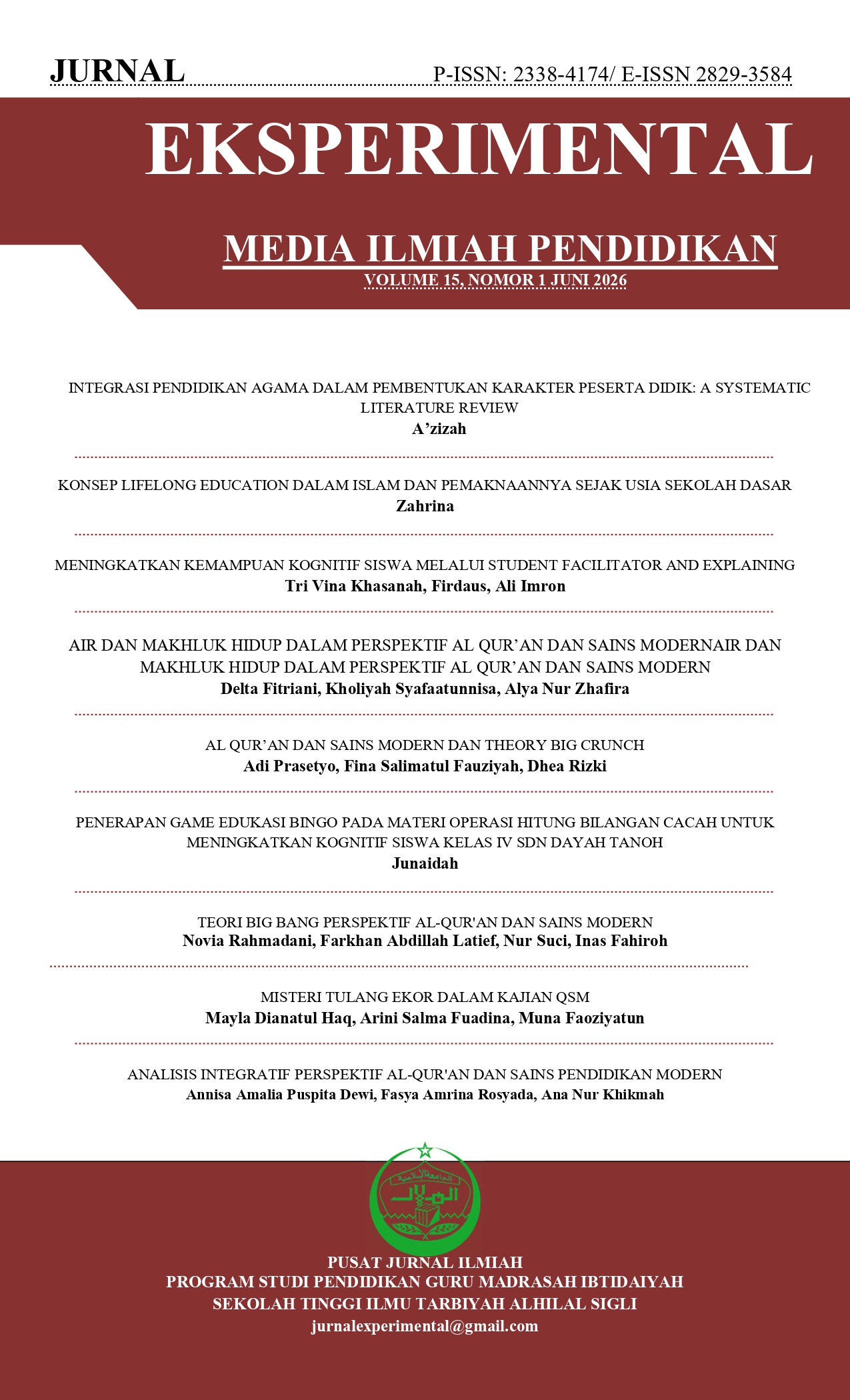
ANALISIS INTEGRATIF PERSPEKTIF AL-QUR'AN DAN SAINS PENDIDIKAN MODERN
Keywords:
Luqman, Qur'an, Islamic education, modern educational science, character educationAbstract
This study aims to analyse the educational values embodied by Luqman in the Qur'an and examine their relevance to the dynamics of modern education through the integration of Qur'anic teachings and contemporary educational science. The research employed a qualitative library research method using an integrative approach. Primary data were obtained from the Qur'an, particularly Surah Luqman verses 12–19, supported by classical and contemporary Qur'anic commentaries, while secondary data were collected from books and scientific journals related to Islamic education and modern educational theories. Data was analysed using content analysis by identifying educational values, interpreting Qur'anic exegesis, and integrating the findings with contemporary educational concepts. The findings reveal that Luqman's educational model emphasizes the values of monotheism (tawhid), gratitude, moral awareness, worship, noble character, and social responsibility. These values are consistent with modern educational theories, including character education, positive psychology, social learning theory, constructivism, and educational neuroscience. The study concludes that Luqman's educational concept represents a holistic educational model that integrates spiritual, intellectual, emotional, and social dimensions. Therefore, it can serve as a relevant paradigm for strengthening Islamic education in addressing the challenges of the digital era and contemporary educational transformation.
References
Al-Attas, S. M. N. (1991). The Concept of Education in Islam. International Institute of Islamic Thought and Civilization (ISTAC).
Bandura, A. (1977). Social Learning Theory. Prentice Hall.
Bruner, J. (1996). The Culture of Education. Harvard University Press.
Goleman, D. (2006). Social Intelligence: The New Science of Human Relationships. Bantam Books.
Hamka, S., & Umarella, S. (2024). Pemikiran Pendidikan Syed Muhammad Naquib Al-Attas dalam The Concept of Education in Islam. Tawazun: Jurnal Pendidikan Islam, Vol. 17, No. 2, 215–228.
Ibn Katsir, I. (2004). Tafsir al-Qur'an al-'Azhim. Dar Tayyibah.
Lickona, T. (2013). Educating for Character: How Our Schools Can Teach Respect and Responsibility. Bantam Books.
Muhaimin. (2012). Paradigma Pendidikan Islam: Upaya Mengefektifkan Pendidikan Agama Islam di Sekolah. Remaja Rosdakarya.
Parina, P., Syihabuddin, S., Somad, M. A., & Kosasih, A. (2025). Toward an Adab-Based Conceptual Character Education Model: Integrating Lickona and Al-Attas in Project-Based Learning for Islamic Elementary Schools. Edukasi Islami: Jurnal Pendidikan Islam, Vol. 14, No. 1.
Qur'an. (n.d.). Surah Luqman [31]: 12–19.
Schwab, K. (2016). The Fourth Industrial Revolution. World Economic Forum.
Seligman, M. E. P. (2011). Flourish: A Visionary New Understanding of Happiness and Well-being. Free Press.
Shihab, M. Q. (2002). Tafsir Al-Misbah: Pesan, Kesan, dan Keserasian Al-Qur'an. Vol. 11. Lentera Hati.
Tokuhama-Espinosa, T. (2018). Neuromyths: Debunking False Ideas About the Brain. Teachers College Press.
UNESCO. (2021). Reimagining Our Futures Together: A New Social Contract for Education. UNESCO Publishing.
Vygotsky, L. S. (1978). Mind in Society: The Development of Higher Psychological Processes. Harvard University Press
Downloads
Published
Issue
Section
License
Copyright (c) 2026 Annisa Amalia Puspita Dewi, Fasya Amrina Rosyada, Ana Nur Khikmah

This work is licensed under a Creative Commons Attribution 4.0 International License.