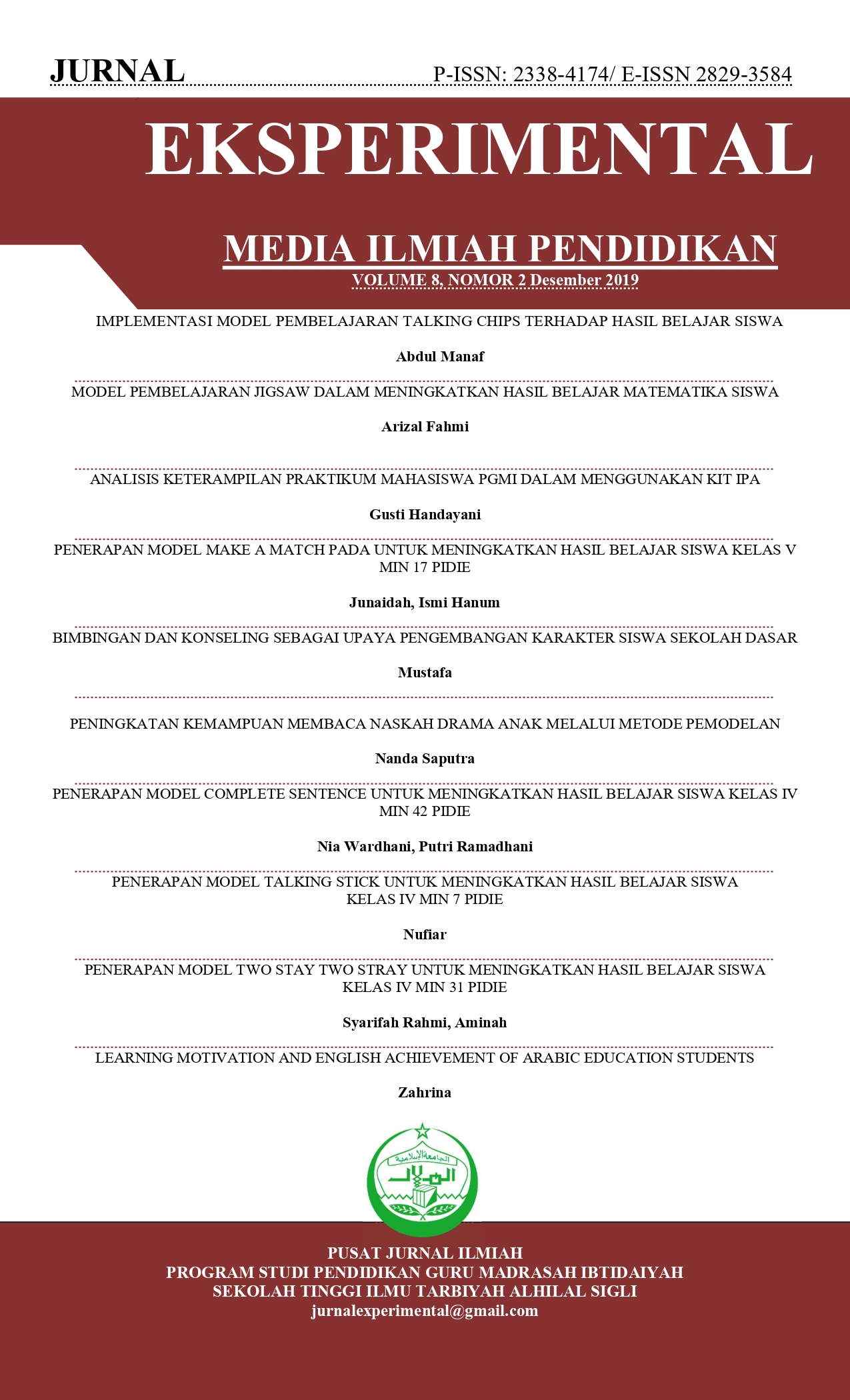
PENINGKATAN KEMAMPUAN MEMBACA NASKAH DRAMA ANAK MELALUI METODE PEMODELAN
Keywords:
Reading Ability, Manuscripts, Modeling MethodsAbstract
This study aims to determine the improvement of children's drama script reading ability using the modeling method. The approach used in this study is a qualitative approach with the type of Classroom Action Research (CAR). Data were taken from test results, observations, and interview results. The data source was 38 of 4th grade students of MIN 41 Pidie. The results showed an increase in the number of students who had completed the learning from 39% in the pre-action test or before the learning took place. Then it increased to 76% in the first cycle, and increased again to 89% in the second cycle. The use of the modeling method can also increase the activity of teachers and the 4th grade students at MIN 41 Pidie when learning to read children's drama scripts. This is evidenced by the increase in the percentage of teacher activity in the first cycle, which is 81% to 91% in the second cycle. Student activity in the first cycle is 83% to 93% in the second cycle. It can be concluded that the modeling method can improve students' ability to read children's drama scripts.
References
Arikunto, S. dkk. 2012. Penelitian Tindakan Kelas. Jakarta: Bumi Aksara
Azhar, Arsyad. 2003. Media Pembelajaran. Jakarta: Raja Grafindo Persada
Harjasujana, Damaianti. 1998. Membaca dalam Teori dan Praktik. Bandung: Mutiara
Kunandar. 2011. Langkah Mudah Penelitian Tindakan Kelas Sebagai Pengembangan Profesi Guru. Jakarta: PT Rajawali Press
Riyanto, Yatim. 1996. Metodologi Penelitian Pendidikan. Surabaya: SIC
Suharianto. 2009. Menuju Pengajaran Sastra Yang Apresiatif. Semarang: Bandungan Institut
Usman, dkk. 2008. Penelitian Tindakan Kelas. Darussalam: Universitas Syiah Kuala
Wahab, Aziz. 2008. Metode dan Model-model Mengajar. Bandung: Alfabeta
Waluyo, Herman J. 2010. Drama Teori dan Pengajaranya. Yogyakarta: Hanindita Graha Widya
Downloads
Published
Issue
Section
License
Copyright (c) 2019 Nanda Saputra

This work is licensed under a Creative Commons Attribution 4.0 International License.