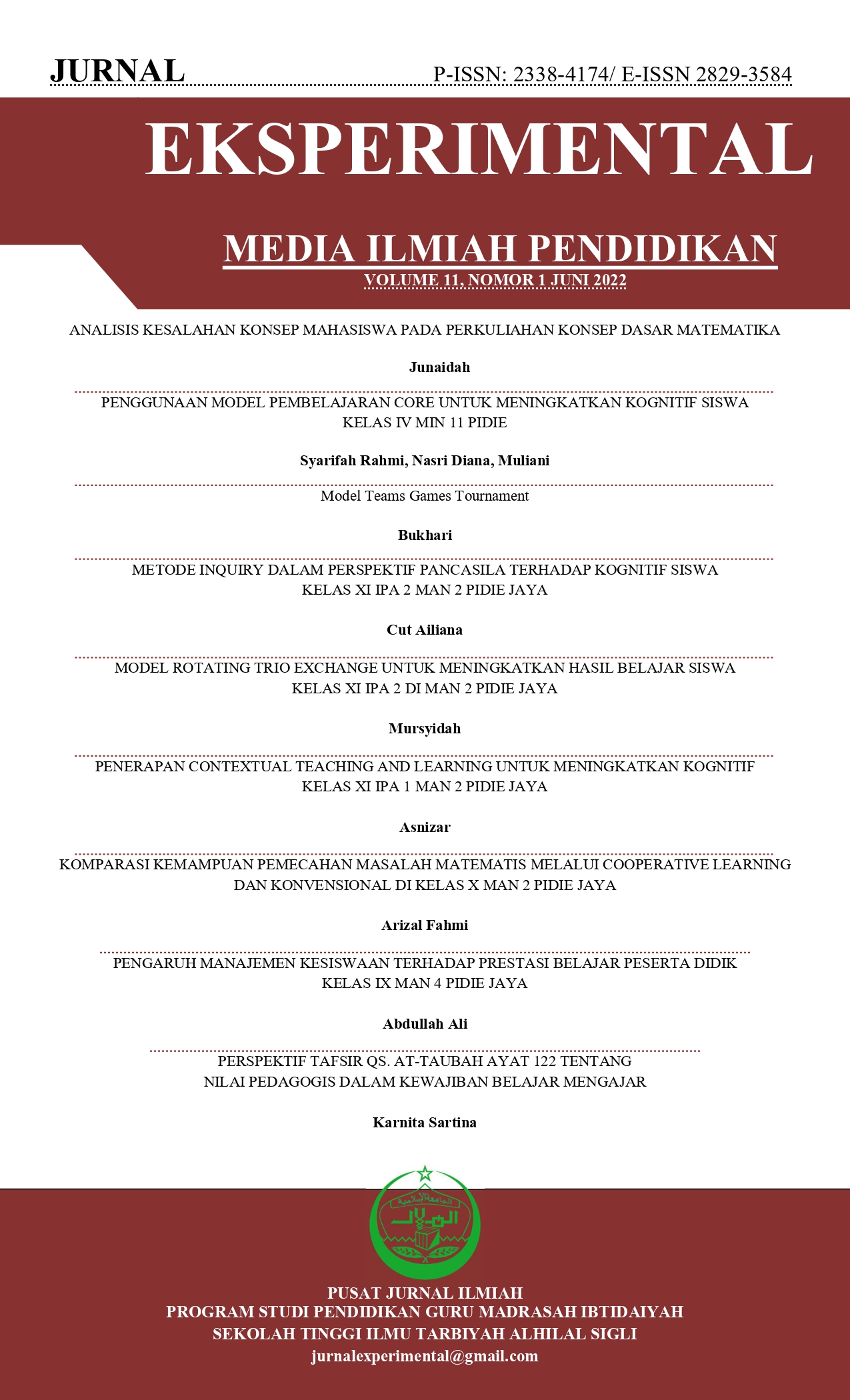
PERSPEKTIF TAFSIR QS. AT-TAUBAH AYAT 122 TENTANG NILAI PEDAGOGIS DALAM KEWAJIBAN BELAJAR MENGAJAR
Keywords:
Surah At-Taubah Verse 122, Pedagogical Value, Obligation to Learn, Obligation to TeachAbstract
This study aims to analyze the pedagogical values contained in Surah At-Taubah verse 122 and their relevance to the obligations of learning and teaching within the perspective of Islamic education. This research uses a library research method with a descriptive qualitative approach. The primary data sources are QS. At-Taubah verse 122 and several relevant tafsir books, while the secondary data sources are books, journal articles, and scientific literature related to Islamic education, learning, and the obligation to seek knowledge. Data collection techniques were carried out through documentation studies and content analysis of relevant sources. The research results show that QS. At-Taubah verse 122 contains pedagogical values that emphasize the importance of role division in seeking knowledge, deepening knowledge, the learning process, and conveying knowledge to society. The verse illustrates that learning and teaching activities are crucial components in building a knowledgeable community. The pedagogical values inherent in the verse include the responsibility to seek knowledge, the importance of deepening one's understanding, knowledge transfer, and the social responsibility to practice and share knowledge. Thus, Surah At-Taubah verse 122 holds strong relevance as a foundational value for the implementation of Islamic education, particularly in fostering a sustainable culture of learning, teaching, and knowledge sharing.
References
BSNP. 2006. Kurikulum Tingkat Satuan Pendidikan SD/MI. Jakarta: Depdiknas
Budiningsih, A. 2011. Belajar dan Pembelajaran. Jakarta: Rineka Cipta
Budiningsih, C. 2012. Belajar dan Pembelajaran cetakan ke-8. Jakarta: Rineka Cipta
Bungin, B. 2012. Metodologi Penelitian Kuantitatif, Jakarta: Kencana Prenada Media Group,
Creswell, J.W. 2010. Research Design: Pendekatan Kualitatif, Kuantitatif, Dan Mixed. Yogjakarta: Pustaka Pelajar
Hasan, C. 1994. Dimensi-Dimensi Psikologi Pendidikan. Surabaya: Al-Ikhlas
Ikklima, B, dkk. 2018. Peningkatan Hasil Belajar Matematika Melalui Model Pembelajaran Discovery Learning Berbantuan Media Gambar pada Siswa Kelas 4 SDN Cukil 01 Kabupaten Semarang Semester II. PENDEKAR: Jurnal Pendidikan Berkarakter. Vol 1, No 1. ISSN: 2615-1421. Hlm 347-353
Mariana, M., & Amri, A. 2020. Hawalah Mutlaqah dalam Perspektif Syafi’iyah dan Hanafiyah. SINTESA: Jurnal Kajiam Islam dam Sosial Keagamaan, Vol. 1 No.2, hlm. 136–147. DOI: http://dx.doi.org/10.22373/sintesa.v1i2.182
Meltzer, D. E. 2002. The Relationship between Mathematics Prepation and Conseptual Learning Gains in Physics : A Possible “Hidden Variable” in Diagnostic Pretest Scores. American Association of Physics Teachers, Vol. 70 Issue 1259.
Narbuko, C. 2009. Metodologi Penelitian, Jakarta : Bumi Aksara
Neolaka, A dan Grace, A. A. N. 2017. Landasan Pendidikan. Depok: Kencana
Nufiar, Mariana, & Muhammad Ali. 2020. Settlement of Problematic Loans in the Unit Pengelola Kegiatan (UPK) of Pidie District did Sharia. Journal of Social Science, Vol. 1 No. 4, hlm 147–151. https://doi.org/10.46799/jsss.v1i4.55
Rohani, Ahmad. 2014. Pengelolaan Pembelajaran Cetakan ke-2. Jakarta: Rineka Cipta
Sujianto, A. E. 2009. Aplikasi Statistik dengan SPSS 16.0. Jakarta: Prestasi Pustaka Karya
Suryosubroto, B. 2010. Proses Belajar Mengajar Di Sekolah Cetakan ke-2. Jakarta: Rineka Cipta
Syafi’i, A. 2015. Metodologi Penelitian Pendidikan. Surabaya: Elkaf
Tanzeh, A. 2009. Pengantar Metode Penelitian. Yogyakarta: Teras
Downloads
Published
Issue
Section
License
Copyright (c) 2022 Karnita Sartina

This work is licensed under a Creative Commons Attribution 4.0 International License.